Platform
One governed record for every building, its equipment and the work done on it.
The foundation under everything Harmelo shows you: what is installed, what was done, who did it, what evidence supports it and what is still missing, in a record that outlasts staff, contractor and ownership changes. Intelligence is what that record lets you decide.
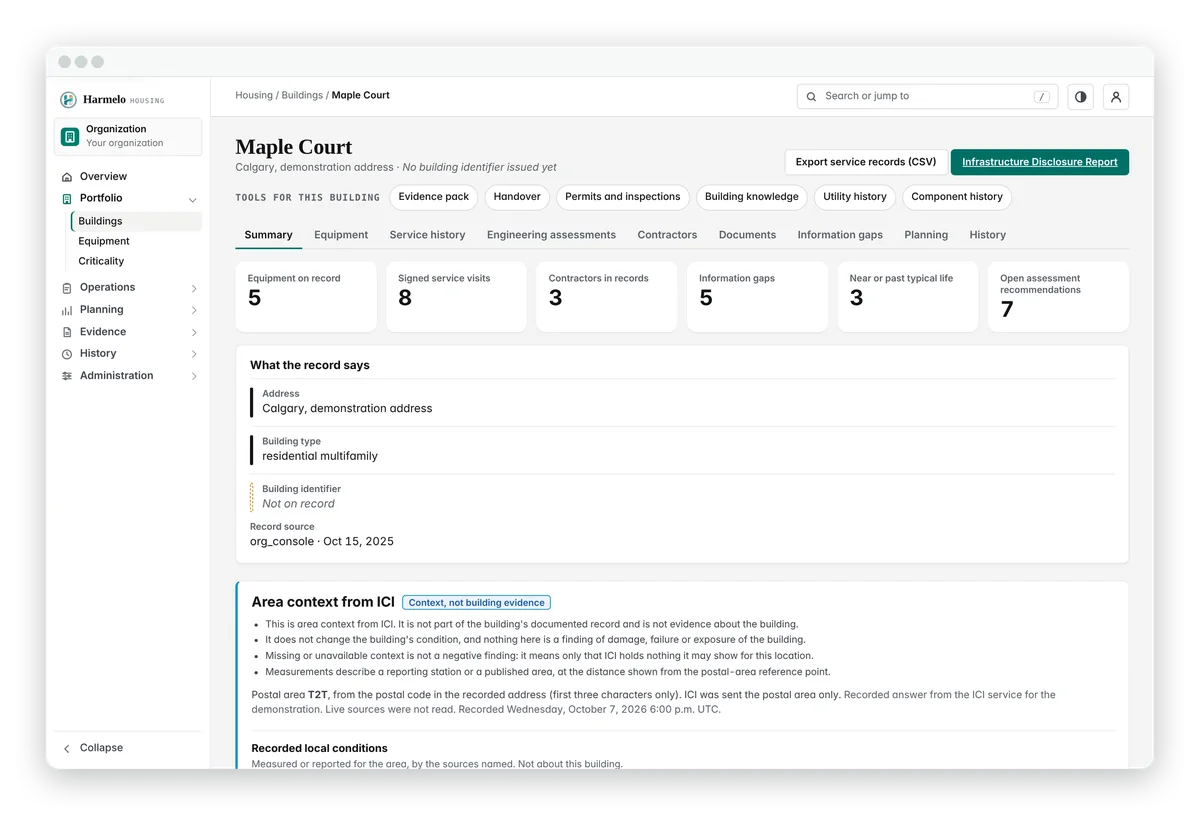
Identity and provenance
The building and each unit of equipment keep one continuing identity, and the history attaches to it.
Every building, and every boiler, rooftop unit, pump or water heater in it, carries a Harmelo identifier. Visits, documents, assessments, inspections, projects and follow-ups are attached to that identifier with their source, so the unit's story reads from installation to today, whoever did the work.
- Building identifiers (HBIN) travel with the building's record through a sale or a custody transfer; a transfer never issues a new one.
- Equipment identifiers (HMIN for mechanical, HEIN for energy systems) are reserved after a collision check and never reused, so a replacement unit starts its own history and the old one is retired with what replaced it.
- Provenance on every fact: a signed visit, a document accepted in evidence review, an entry or import, or an engineering assessment, with who recorded it in Audit.
- An internal identity system. These are Harmelo's own persistent record identifiers. They are not a government, land-title or other official registration, and they do not certify the equipment or the work.
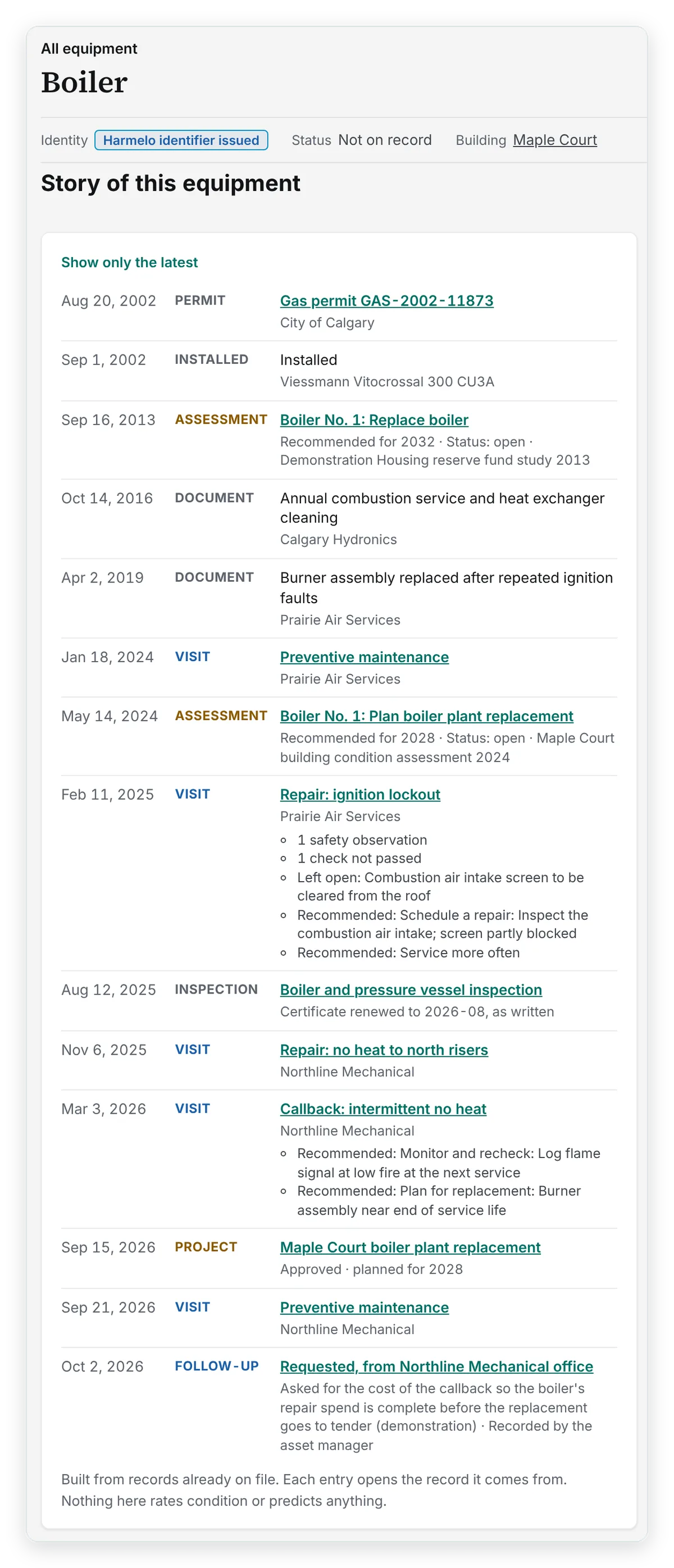
The building record
Everything the building has, and everything known about it.
Each building holds its equipment, documents, permits, engineering assessments, warranties, signed visits and what is still unknown. Every fact carries where it came from: a document, a signed technician observation, information entered or imported, or an engineering assessment.
- Identity: buildings and equipment carry Harmelo identifiers that survive a change of contractor, software or owner. They are internal record identifiers, not an official registration.
- Statement classes: a documented fact is shown differently from a planning assumption.
- Honest gaps: missing information is listed as missing, never as a defect.
- The problem
- Nobody can say with confidence what is installed, or how they know.
- What Harmelo does
- Each building holds its equipment, documents and visits, every fact with its class and source, and missing information named.
- The outcome
- Decisions start from a documented record a board, an insurer or a buyer can read for themselves.
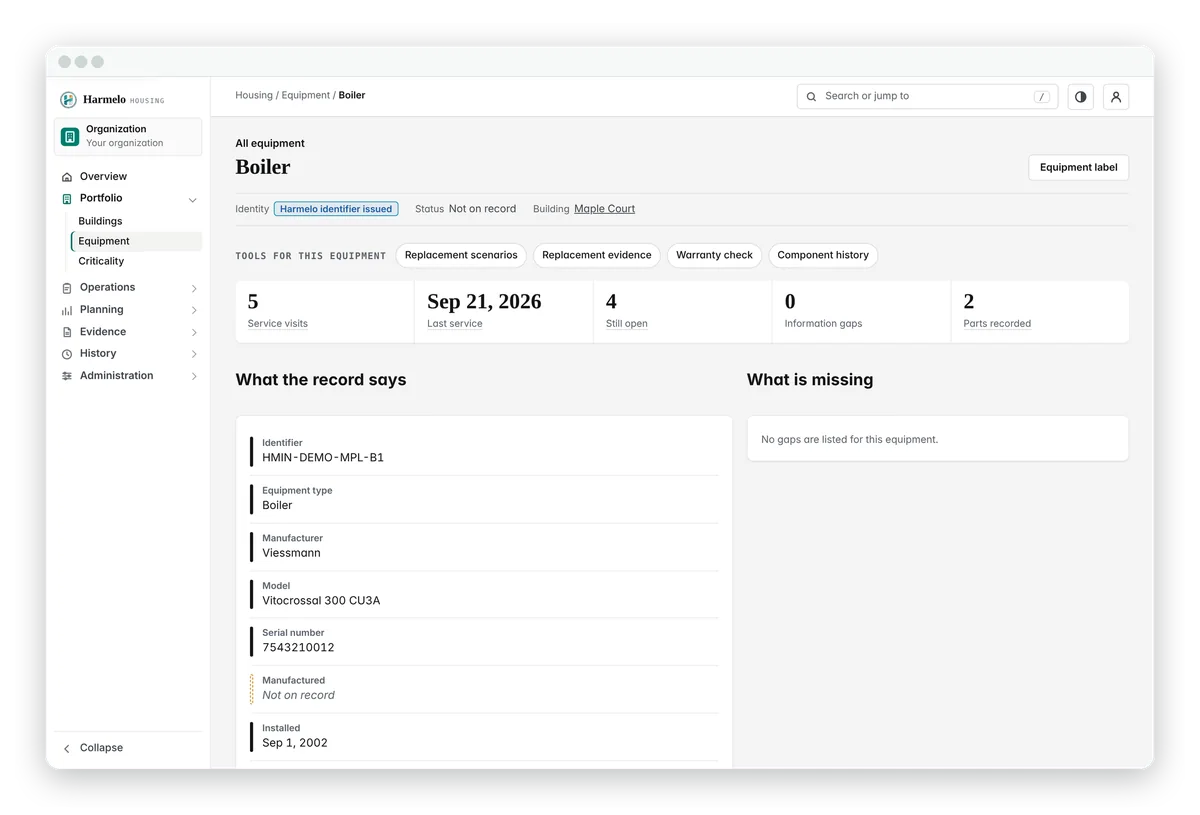
How information enters
Four ways in, each with its source kept.
Equipment and service continuity
Keep service history with the equipment when contractors or staff change.
Every signed visit is filed against the unit it was done to, by the company and technician who did it. Repeat service and contractor changes show up across visits, so the next technician starts where the last one finished.
- The problem
- A new contractor diagnoses from scratch.
- What Harmelo does
- Signed visits stay with the unit across every company and technician.
- The outcome
- Fewer repeat diagnostics, and continuity that survives a contract change.
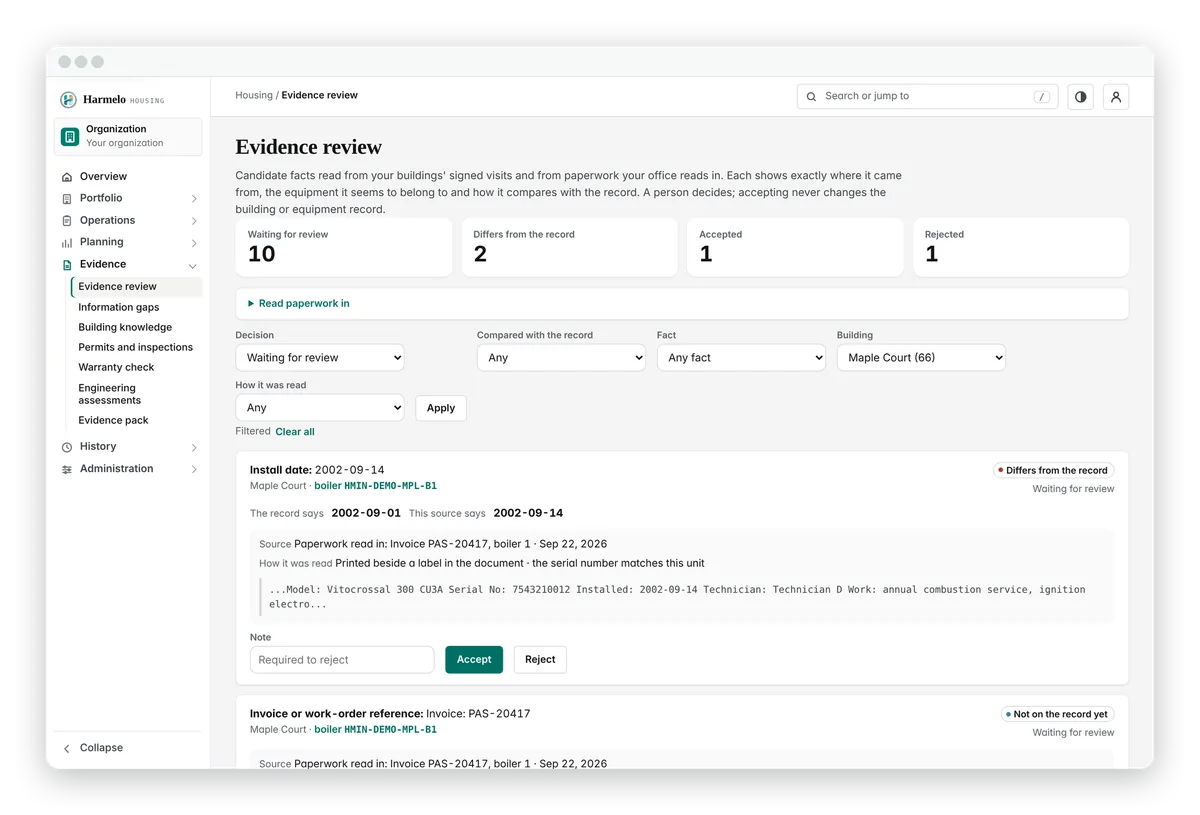
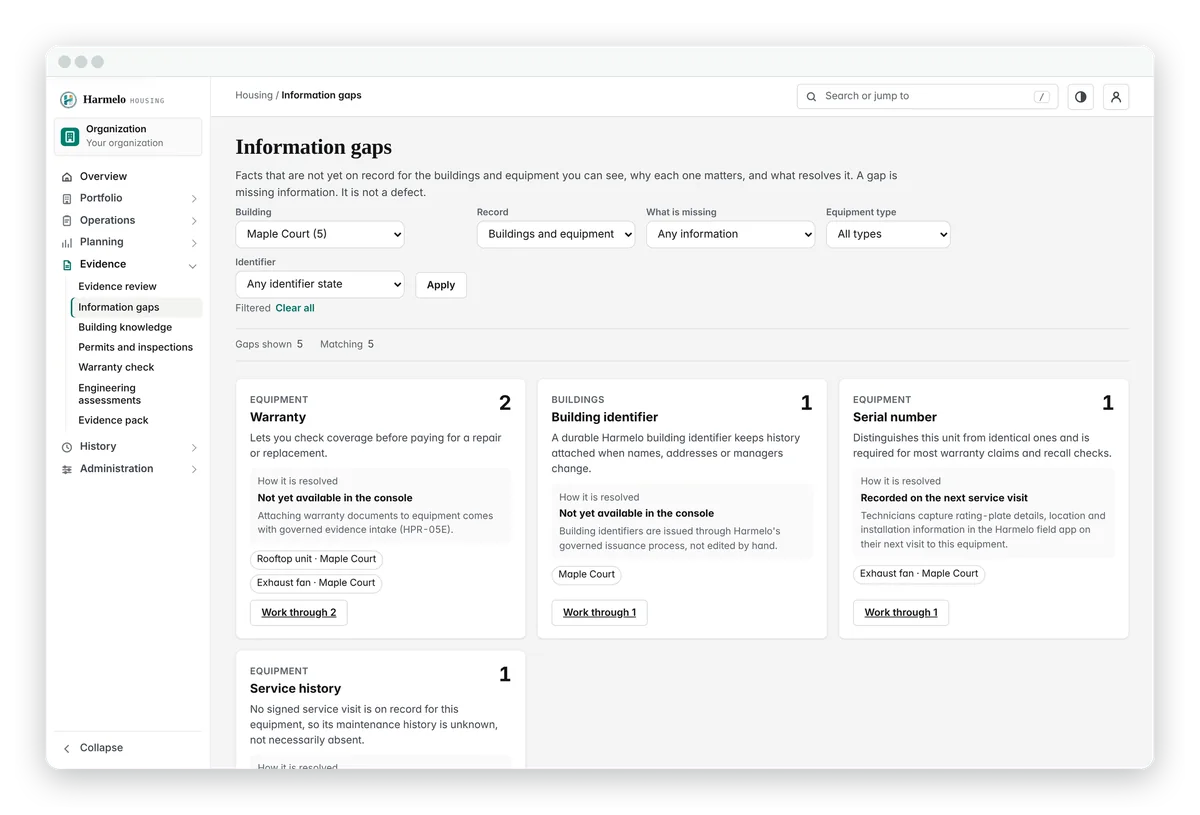
Evidence and information gaps
A person decides what changes the record.
Candidate facts read from signed visits and paperwork wait in evidence review until someone accepts or rejects them. Information gaps are counted per building and per kind, with the way each one is resolved.
- The problem
- Paperwork is read once and its facts are typed in by whoever is available.
- What Harmelo does
- Candidate facts from paperwork and visits wait in review; a person accepts or rejects each one.
- The outcome
- The record changes only on evidence someone stood behind.
Field to office
Captured once, at the equipment.
The field app guides the technician through the checklist the property requires, with readings, photos, parts, findings and the sign-offs the template asks for. The office sees what each record still needs before it goes to the customer.
- The problem
- Field notes arrive incomplete and are retyped.
- What Harmelo does
- Required sign-offs come from the checklist template, and office completion shows what is missing.
- The outcome
- One visit produces a complete record and a customer summary.
- Required sign-offs come from the governed checklist template, not from memory.
- Office completion shows what is missing from each signed visit.
- The customer summary is drawn from the same signed record.
Permissions
The organization holding the record decides who reads and writes it.
Handover and continuity
When the building changes hands, the history goes with it.
Handover review shows what is known, what is missing and what will move, for a sale, a new manager or a new operator. Nothing is transferred without the owner's decision.
- The problem
- A sale or a new manager restarts the history.
- What Harmelo does
- Handover review shows what is known, what is missing and what will move.
- The outcome
- The next party starts from the record, and the owner decides what moves.
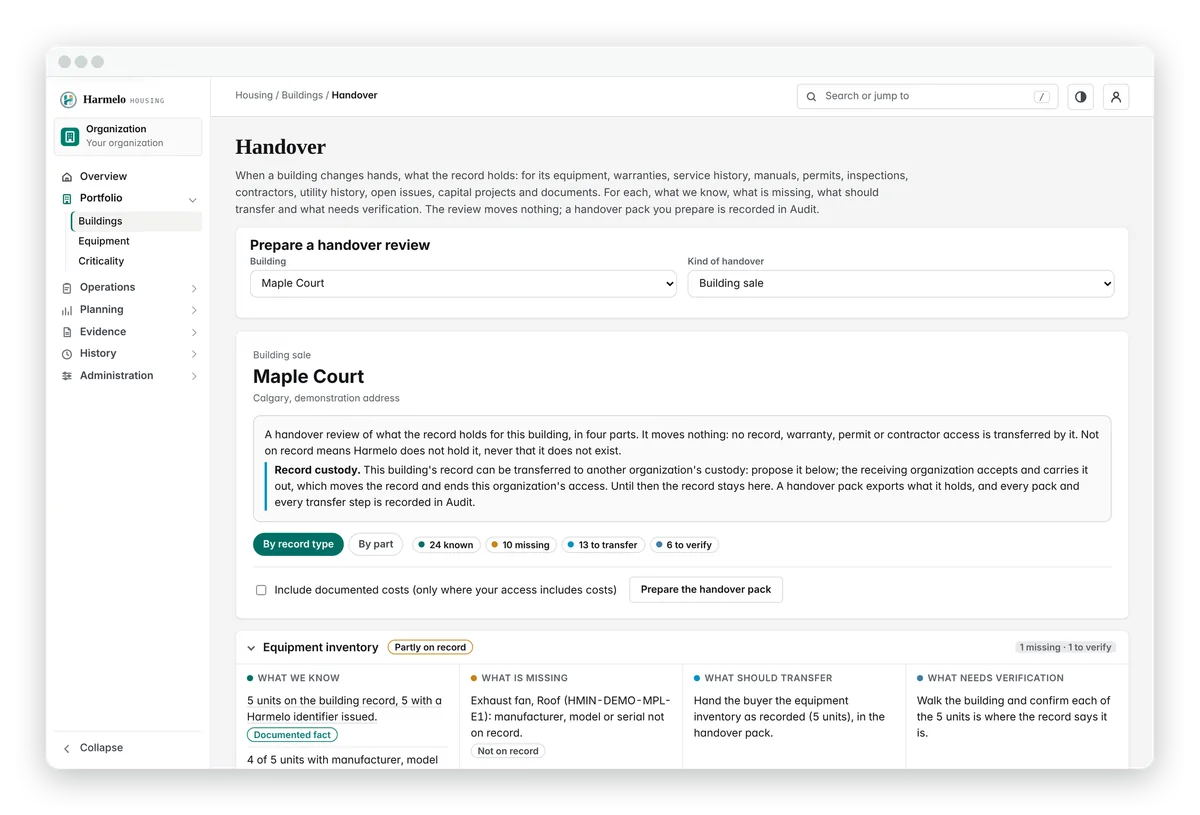
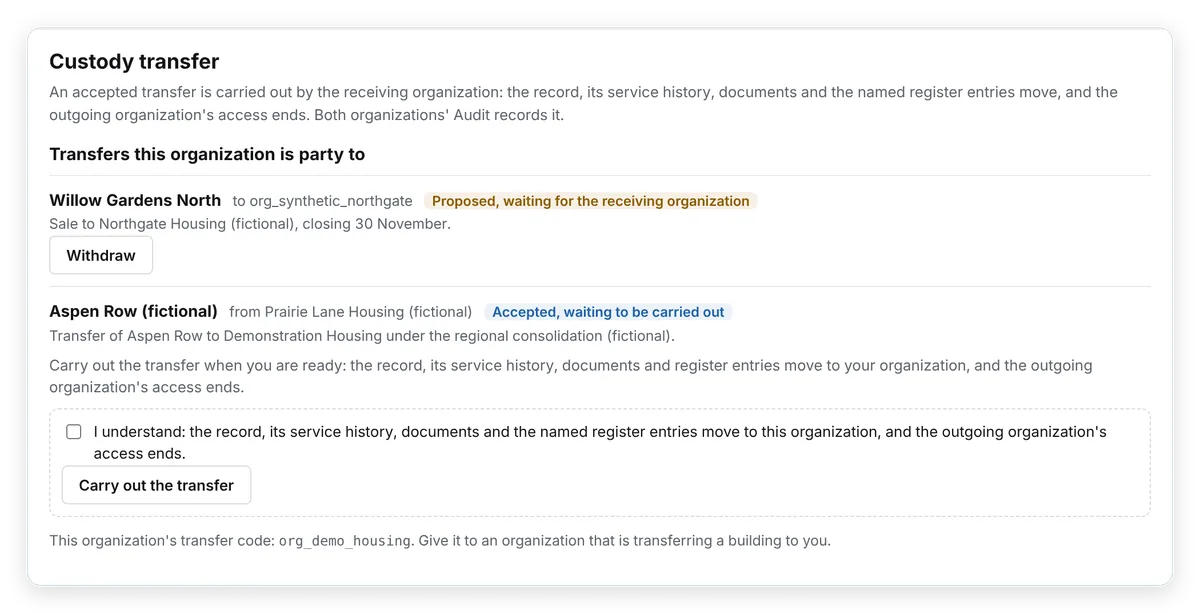
Then the authorized transfer moves the record.
- Propose. The outgoing organization proposes the transfer to the receiving organization's transfer code, with a manifest of what moves and what stays.
- Accept. The receiving organization accepts or declines. Only an organization with governed roles and permissions can accept a building into its custody.
- Carry out. The receiving organization confirms, and the record moves with its service history, documents, permits, warranty cases, manuals, projects and assessments. Copies are made before anything is removed, and an interrupted transfer resumes where it stopped.
- Access ends. The outgoing organization's access to the building ends. Both organizations' Audit records every step.
Working notes, other parties' confidential material and contractor access do not transfer. A home connected to an organization stays its owner's.
Institutional outputs
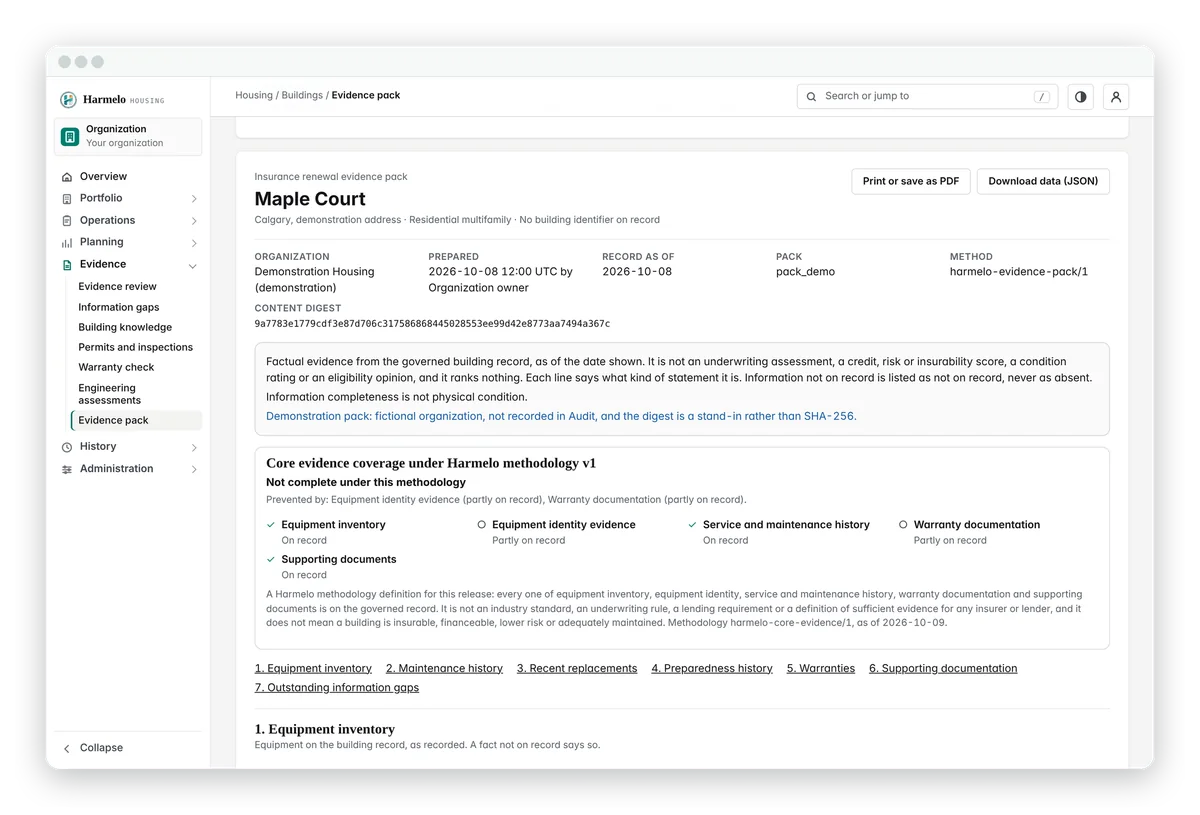
Evidence outputs drawn from the same record.
Every statement carries its class: documented fact, technician observation, entered or imported, engineering assessment, planning assumption or not documented. Nothing is a certification, an inspection or a score.
Infrastructure Disclosure Report
A report on one building: systems and equipment on record, signed service history, technician findings, history from documents, replacements, the engineering baseline and what is not documented.
Evidence packs
Sections chosen for the purpose (insurance renewal, lender review, financing, acquisition or due diligence), with documented costs only where the reader's access includes them. Preparing a pack is recorded in the audit history.
Works alongside your CMMS and property-management system
It complements the systems that run the work. It does not duplicate them.
A CMMS is built around the work order: open it, assign it, close it. A property-management system is built around the lease and the ledger. Both are good at today's work, and both lose the asset's history when a contract, a vendor or the software changes. Harmelo is built around the asset and its evidence, so it holds what those systems were not designed to keep.
Existing equipment lists and service records come in through import and are marked as imported, not as documented. Harmelo has no public API or live connector to another named product today; connections are scoped with technology partners.
Next step
See the platform on buildings like yours.
A virtual walkthrough of the workspace, the field app and the evidence outputs, using demonstration data.